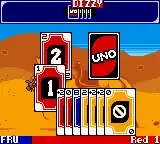
Play Uno (USA) online! It is one of the top-rated Game Boy Color games you can play for free. No download, emulator, or setup required—jump straight into the action directly in your browser and start playing this classic in seconds.
Core Gameplay Mechanics and Difficulty
The charm of Uno lies in its accessible yet strategically demanding gameplay. Players take on the role of hand management, seeking to deplete their cards by matching colors or numbers, while also utilizing action cards to disrupt opponents. This creates a dynamic where tactical decision-making and social interaction are integral to the experience. Each game unfolds uniquely, as players must read the group and anticipate moves, making the difficulty feel fresh even after numerous sessions.
One standout aspect is the inclusion of “wild” and “skip” cards, which not only add variety but also allow for clever strategies to unfold. As players scramble to be the first to declare “Uno,” the tension builds, making each session exhilarating. This combination of simplicity and depth has made Uno a beloved game across generations, easily adaptable to both casual and competitive settings.
Historical Release Background and Cultural Impact
Introduced in 1971, Uno was created by Merle Robbins, initially as a family project intended to resolve disagreements over existing card games. Its unique premise quickly gained traction, leading to its commercial release by International Games, and later by Mattel. Over the decades, it has evolved from a simple family game into a staple of social gatherings, celebrated for its ability to bring together friends and families.
The societal impact of Uno is profound. This game has navigated cultural shifts, maintaining its relevance through adaptations like themed editions and digital versions that cater to modern gaming preferences. Its presence in pop culture—from references in TV shows to being featured in tournaments—illustrates its enduring appeal. The game has even inspired dedicated communities, solidifying its status as a classic that transcends age and geography.
The Legacy of Uno Today
Today, Uno remains a beloved choice in the board game resurgence. Its simplicity makes it a go-to for family game nights, while the strategic aspects keep dedicated players engaged. The game has also influenced various modern card games, cementing its legacy in the gaming world. With annual tournaments and a wide social media presence, Uno continues to thrive, celebrated as a timeless element of entertainment.
Conclusion
The enduring appeal of Uno can be attributed to its combination of engaging mechanics, rich history, and cultural significance. It has successfully fostered connections among people of all ages while adapting to changing times without losing its core essence. As both a nostalgic reminder of simpler times and a dynamic game suited for today’s players, Uno is indeed a classic that will continue to resonate for years to come.