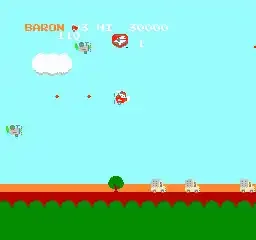
Play Sky Kid (USA) online! It is one of the top-rated Nintendo Entertainment System games you can play for free. No download, emulator, or setup required—jump straight into the action directly in your browser and start playing this classic in seconds.
Gameplay and Difficulty
The core mechanics of Sky Kid revolve around a blend of side-scrolling action and strategic gameplay. Players take on the role of a World War I pilot navigating a bi-plane through various levels, each filled with enemy aircraft and ground targets. The objective is not just to shoot down foes, but also to land effectively on designated airstrips after each mission. This feature adds a layer of challenge, as players must balance offensive maneuvers with precision landing.
The difficulty ramps up significantly as the game progresses, with later levels introducing more complex enemy formations and treacherous environments. Birds, balloons, and even anti-aircraft fire create a chaotic atmosphere that keeps players on their toes. Over time, the game’s combination of action and strategy gained a loyal following; many remember the exhilarating feeling of dodging bullets while plotting a successful landing.
Historical Context and Legacy
Released in 1985 by Namco, Sky Kid represents a significant moment in the realm of arcade gaming. It emerged during a golden era when arcade machines were becoming focal points of entertainment across America. The game’s charming graphics and catchy soundtrack contributed to its appeal, setting a standard for future titles in the shoot-’em-up genre. The visuals utilized vibrant colors that captured the spirit of its time, while the sound design kept players engaged.
Over the decades, Sky Kid has been celebrated in various compilations and anniversaries, cementing its status within retro gaming communities. Its influence can be seen in subsequent titles that incorporate dual gameplay strategies—where instead of simply shooting, players must also navigate tricky landing sequences. Today, the game still holds a special place in the hearts of nostalgic gamers and is often revisited for its unique mechanics and charming aesthetic.
Cultural Impact
Beyond its gameplay, Sky Kid has left a lasting impression on popular culture. It is frequently referenced in game design discussions for its innovative blend of riding action with landing mechanics. Furthermore, the game had a significant impact on the development of later flight simulation games, serving as an inspiration for developers looking to create immersive aerial experiences. Gamers today cherish it not only for its nostalgic value but also for its pioneering contributions to the genre.
In conclusion, Sky Kid remains a significant title in retro gaming history. With its challenging gameplay, charming graphics, and notable innovations, it resonates with a wide audience, both new and old. Its legacy continues to influence modern game design, ensuring that its impact will be felt for generations to come.