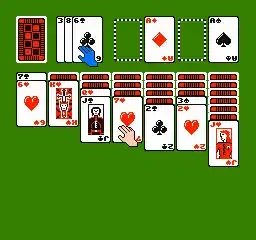
Play Solitaire (USA) (Unl) online! It is one of the top-rated Nintendo Entertainment System games you can play for free. No download, emulator, or setup required—jump straight into the action directly in your browser and start playing this classic in seconds.
Exploring the Legacy of Solitaire
The timeless classic, Solitaire, has become synonymous with single-player card games since its inception. Originally popularized on Windows PCs in the 1990s, this game combines strategy and chance in a captivating manner that has drawn players across generations. With simple rules and engaging gameplay, it has transcended its origins to become a cultural icon, evoking nostalgia for those who spent countless hours engrossed in its challenges.
Game Mechanics and Difficulty
Solitaire involves manipulating a deck of cards to achieve a single goal: move all cards to foundation piles based on suit. The game starts with a tableau of cards arranged in a specific layout, requiring players to think critically and strategically. Players can draw cards from the stockpile and place them on the tableau, hoping to clear the board efficiently. The inherent difficulty lies in its reliance on both strategy and luck, compelling players to hone their skills while accepting that not every game can be won.
- Simple rules and easy to learn
- Varied winning strategies
- Challenges from both layout and card draws
Historical Background and Evolution
First introduced in the late 1980s as a digital game, Solitaire gained widespread popularity when bundled with Microsoft Windows. This strategic card game showcased the potential of personal computers for entertainment, transforming leisure time and creating a thriving market for casual gaming. Over the years, it has evolved with various versions and adaptations, but its core gameplay remains beloved, demonstrating the power of simple, accessible entertainment.
A Lasting Cultural Impact
Throughout its journey, Solitaire has left an indelible mark on the landscape of gaming. It introduced millions to computer gaming and served as a gateway for many to explore a broader world of video games. Its easy accessibility made it a hallmark of tech literacy for new computer users, while the solitary nature of the game appealed to those looking for a respite from the busy world. As a result, it continues to thrive in various formats, reminding players of the beauty of strategy and the thrill of chance.
Today, Solitaire remains more than just a card game; it stands as a testament to the era of early personal computing and an example of how simple ideas can lead to lasting legacies. As players continue to rediscover its charm, it’s clear that the spirit of this classic game will endure for years to come.