Play Tomb Raider online! It is one of the top-rated PlayStation PSX games you can play for free. No download, emulator, or setup required—jump straight into the action directly in your browser and start playing this classic in seconds.
Few debut titles have reshaped an entire industry quite like Tomb Raider did in 1996. Released by Core Design and published by Eidos Interactive, this groundbreaking action-adventure introduced the world to Lara Croft, a character who would go on to become one of gaming’s most recognizable figures. While the game first launched on Sega Saturn, it was the PlayStation version that cemented Tomb Raider’s legendary status, blending 3D exploration, puzzle-solving, and cinematic presentation in a way console gaming had never quite seen before. Here’s a deep dive into the original Tomb Raider on PS1.
What Is Tomb Raider (1996)?
Tomb Raider is an action-adventure game developed by Core Design and published by Eidos Interactive, first released on Sega Saturn in October 1996, with the PlayStation and MS-DOS versions following closely behind that November. As the debut entry in what would become a massive media franchise, the game followed archaeologist-adventurer Lara Croft as she is hired by the mysterious businesswoman Jacqueline Natla to recover an ancient artifact known as the Scion of Atlantis.
Development began around 1993 and took roughly 18 months to complete, produced by a small six-person team at Core Design’s Derby, England studio, working on a modest budget of approximately £440,000. Despite its humble origins, the finished game would go on to influence 3D action-adventure design for decades to come.
The Story: A Global Hunt for the Scion of Atlantis
The game follows Lara Croft, daughter of an aristocratic English family, as her life takes an unexpected turn following a plane crash in the Himalayas that leaves her stranded and forced to survive on her own instincts. That transformative experience sets her on a new path as a professional adventurer, eventually leading her to accept a job from Natla to track down the pieces of the Scion, a powerful ancient relic tied to the lost civilization of Atlantis.
Lara’s search takes her across a striking variety of global locations, including the mountains of Peru, the ruins of Greece, the tombs of Egypt, and ultimately the sunken city of Atlantis itself, weaving exploration, combat, and puzzle-solving into a sprawling adventure that was massively ambitious for its time.
The Creation of Lara Croft
Lara Croft was conceived by Toby Gard, who served as the game’s lead artist and is credited as her original creator. Interestingly, Lara wasn’t part of the original concept from the start, early development actually began with a male placeholder character before the design team decided that stealth and puzzle-solving, rather than pure combat, should define the game’s core, a shift that ultimately steered the character toward a different direction entirely.
The character was initially named Laura Cruz before being refined into the aristocratic English adventurer fans know today, drawing inspiration from a mix of pop culture influences, including Tank Girl, Indiana Jones, and Hard Boiled. Following the game’s release, Lara Croft quickly transcended gaming to become a bona fide media phenomenon, appearing in advertising campaigns, magazine covers, and countless cross-promotional deals rarely afforded to video game characters at the time.
Gameplay: Exploration, Puzzles, and Combat in 3D
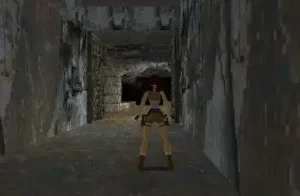
Tomb Raider placed players in a fully 3D, third-person perspective, a rarity for console games in 1996. Lara’s moveset was remarkably deep for the era, allowing her to run, jump, vault, swim, climb, roll, and perform acrobatic maneuvers while navigating elaborate room complexes filled with traps, switches, and environmental puzzles.
Combat was handled through an auto-targeting system that let Lara instinctively track nearby enemies, freeing players to focus on movement and positioning rather than manual aiming, an approach that allowed for fluid, dynamic firefights even while somersaulting or running through hostile rooms. The game’s custom 3D level editor gave designers the freedom to build intricate, labyrinthine puzzle rooms that became a defining feature of the series’ identity.
The PlayStation Version’s Save System
One aspect that particularly stood out, for better or worse, on the PlayStation and Sega Saturn versions was Tomb Raider’s save system. Unlike the MS-DOS version, which allowed saving at any point, console players could only save their progress at specific in-level checkpoints marked by a floating blue save crystal. This scarcity meant that dying often forced players to replay significant chunks of a level, a design choice that drew criticism at the time and led Core Design to implement a more flexible save-anywhere system in the following sequel, Tomb Raider II.
Critical Reception and Commercial Success
Tomb Raider was widely praised upon release for its innovative 3D graphics, fluid controls, and ambitious level design, and it went on to win numerous industry awards. The PlayStation version alone sold roughly seven million copies worldwide, making it one of the best-selling games on the console and the top-selling entry in the Tomb Raider franchise until the series’ 2013 reboot decades later.
Beyond commercial success, the game earned lasting cultural recognition. In 2006, it was voted one of Britain’s top design achievements as part of the BBC and Design Museum’s Great British Design Quest, placing it alongside British icons like the Mini and Concorde. In 2020, Tomb Raider was also honored on a series of Royal Mail postage stamps celebrating classic UK video games.
Legacy and Modern Re-Releases
The original Tomb Raider laid the foundation for a franchise that has sold over 100 million copies worldwide across its history. Following its success, Core Design continued developing the series through several sequels before Crystal Dynamics eventually took over the franchise. The original game has seen numerous ports and remasters over the years, most notably as part of Tomb Raider I–III Remastered, released in February 2024 by Aspyr in partnership with Crystal Dynamics for modern platforms including PlayStation 5, Windows, Xbox Series X/S, and Nintendo Switch, featuring updated controls and refreshed visuals while preserving the original’s level design and atmosphere.
Why the Original Tomb Raider Still Matters
Nearly three decades after its release, Tomb Raider remains a landmark achievement in gaming history, not just for popularizing 3D action-adventure design, but for introducing one of the medium’s most enduring protagonists. Its blend of atmospheric exploration, clever environmental puzzles, and cinematic ambition set a template that countless later games would follow. For anyone curious about the roots of modern adventure gaming, the original 1996 Tomb Raider remains a foundational piece of PlayStation history.
Frequently Asked Questions
1. When was Tomb Raider released on PlayStation?
Tomb Raider was released on PlayStation in November 1996 in North America and Europe, shortly after its initial launch on Sega Saturn in October of that year. A Japanese PlayStation release followed in early 1997.
2. Who created Lara Croft?
Lara Croft was created by Toby Gard, who served as lead artist on the original Tomb Raider at Core Design. She was originally conceived under the working name Laura Cruz before evolving into the aristocratic British archaeologist featured in the final game.
3. Why was the PS1 version of Tomb Raider considered difficult?
A major factor was the game’s restrictive save system, which only allowed saving at specific save crystal checkpoints within each level. Dying meant replaying substantial portions of a level, contributing significantly to the game’s reputation for difficulty compared to the MS-DOS version, which allowed saving at any time.
4. Can I play the original Tomb Raider on modern platforms?
Yes. The original 1996 game is available as part of Tomb Raider I–III Remastered, released in February 2024 for PlayStation 4, PlayStation 5, Windows, Xbox One, Xbox Series X/S, and Nintendo Switch, featuring updated control options and enhanced graphics while retaining the original level design.