Play Test Drive II – The Duel (USA, Europe) online! It is one of the top-rated SEGA Genesis games you can play for free. No download, emulator, or setup required—jump straight into the action directly in your browser and start playing this classic in seconds.
In the late 1980s, the digital asphalt beckoned, promising high-octane thrills and the fantasy of driving exotic supercars. Amidst this burgeoning era, one title stood out for its blend of speed, luxury, and competitive spirit: Test Drive II – The Duel. Released by Accolade in 1989, this seminal racing game captivated a generation of players across various platforms, from the Commodore 64 to the Amiga and PC. It wasn’t just another racing game; it was an experience that pitted player skill against formidable AI, the clock, and the ever-present threat of law enforcement, cementing its place as a true retro classic.
The Duel’s Engine: Gameplay, Mechanics, and Challenge
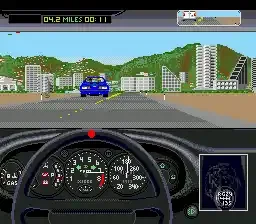
At its core, Test Drive II offered a simple yet compelling premise: race an exotic car against a rival AI driver across scenic, winding roads. Players chose between two automotive titans, the Ferrari F40 or the Porsche 959, each boasting distinct handling characteristics that added a layer of strategic depth. The gameplay was a test of precision and nerve, demanding players navigate traffic, avoid roadside obstacles, and outrun persistent police cruisers determined to end the high-speed chase. Unlike many arcade racers, this title introduced a rudimentary damage model and fuel consumption, forcing players to manage their resources and drive with a degree of caution, adding to the challenge.
The difficulty curve was steep, making every successful segment feel like a hard-won victory. The sense of speed, achieved through clever sprite scaling and parallax scrolling, was groundbreaking for its time, immersing players in the thrill of the race. The iconic split-screen view, even in single-player, emphasized the competitive nature of the game, constantly reminding you of your opponent’s progress. This blend of realistic (for the era) physics, challenging obstacles, and competitive racing made Test Drive 2 The Duel a benchmark for the genre.
Beyond the Checkered Flag: Legacy and Cultural Impact
Released during a pivotal moment for home computing and console gaming, Test Drive II built upon the foundation of its predecessor, pushing boundaries in graphics and sound. It was one of the first games to truly license and showcase real-world supercars, fueling a generation’s automotive dreams. The game’s innovative use of interchangeable disk sets, allowing players to purchase new cars and tracks, was an early precursor to modern DLC, extending its lifespan and appeal. Its cultural impact stemmed from its ability to deliver an aspirational fantasy – the thrill of illicit, high-speed driving in dream machines – directly into players’ homes.
Why does Test Drive II still resonate today among fans of retro racing games? Its lasting legacy is multifaceted:
- Pioneering 16-bit graphics and digitized sound that set new standards.
- Introduction of officially licensed exotic cars, a major draw for enthusiasts.
- Challenging, realistic (for its time) driving physics and environmental hazards.
- The iconic “duel” mechanic against a skilled AI opponent, fostering intense competition.
It wasn’t just a game; it was a statement about what racing simulations could achieve on home systems.
Test Drive II – The Duel remains a beloved entry in the pantheon of classic racing games. Its combination of cutting-edge visuals, challenging gameplay, and the sheer allure of high-performance vehicles left an indelible mark on the industry. It defined a generation’s understanding of digital speed and competition, proving that a simple premise, executed with passion and innovation, could create an enduring legacy. For many, it wasn’t just a game; it was the ultimate digital joyride.