Play Kirby’s Dream Course (USA) online! It is one of the top-rated Super NES games you can play for free. No download, emulator, or setup required—jump straight into the action directly in your browser and start playing this classic in seconds.
Rediscovering the Joys of Kirby’s Dream Course
Kirby’s Dream Course was a unique foray into the realm of golf games for the Super Nintendo Entertainment System (SNES), merging traditional sports mechanics with the whimsical charm of the Kirby franchise. Released in 1994, it transformed the classic golf experience by allowing players to control Kirby, using his signature abilities to navigate imaginative courses featuring intricate designs. As a product of an era when gaming challenged norms, this title invites nostalgia by reminding players of a time when creativity took precedence over realism in video games.
Gameplay Mechanics and Difficulty
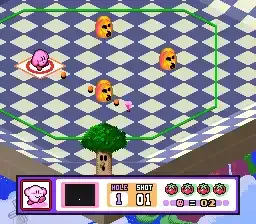
In Kirby’s Dream Course, players embark on an engaging adventure where the objective is to guide Kirby through various planets and courses, each laden with obstacles and enemies. Instead of traditional golfing elements, players “play” through a series of mini-golf-like holes, utilizing Kirby’s abilities to inhale enemies and manipulate the course’s challenges. The game’s difficulty ramps up significantly as players progress through the stages, requiring strategic thinking and precise control. Successful navigation rewards players with power-ups and new abilities, enhancing the overall experience and making each round feel fresh and exciting.
Innovative Design Elements
Graphically, Kirby’s Dream Course stands out with colorful and imaginative art design reminiscent of the vibrant worlds found in the Kirby series. The use of 3D graphics on the 2D plane was a noteworthy innovation for its time, allowing for engaging visual perspectives. Additionally, the incorporation of multiplayer mode provided a competitive edge, allowing friends to challenge each other’s skills while fostering camaraderie. These design choices, combined with intuitive mechanics, created a unique gameplay experience that was both accessible to newcomers and challenging for seasoned gamers.
A Lasting Cultural Legacy
Even decades after its release, Kirby’s Dream Course continues to resonate with fans of retro gaming. The title is often celebrated as an example of creative level design and playful mechanics that encourage exploration and keen strategy. It stands out in the Kirby franchise, illustrating how innovative game design can blend genres effectively. The enduring love for this game is a testament to its influence within the gaming community and its importance in shaping future titles. As gaming technology advances, the charm and creativity of this classic are often revisited, ensuring its place in the hearts of both old and new gamers alike.
In summary, Kirby’s Dream Course is more than just a game; it’s a piece of gaming history that showcases what makes video games a truly unique form of entertainment. By reimagining sports gameplay, fostering creative problem-solving, and inviting playfulness into its design, it remains a nostalgic gem in the ever-expanding tapestry of video game culture.