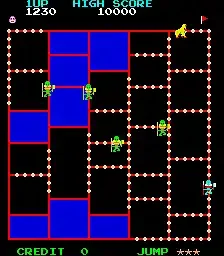
Play Amidar online! It is one of the top-rated Arcade games you can play for free. No download, emulator, or setup required—jump straight into the action directly in your browser and start playing this classic in seconds.
Unpacking the Gameplay Mechanics of Amidar
The essence of Amidar lies in its unique blend of maze navigation and strategy. Released by Konami in 1981, this game pushes players to control a character that must paint a grid while avoiding enemy creatures. The main objective is to fill in squares on the grid without being tagged by antagonistic opponents. This mechanic introduced a layer of strategy where players must navigate not just the maze, but also their timing, as the enemies move unpredictably.
Amidar’s difficulty increases steadily, making players hone their skills as they progress. The game employs an innovative dual-level system: moving between the grid and the outer edges where players can gain bonuses. The tension between painting squares and dodging enemies creates a captivating gameplay experience that is both challenging and satisfying. The strategic thinking required to anticipate enemy movements adds depth and keeps players engaged, making it a memorable title for those who enjoyed classic arcade games.
The Historical Context and Cultural Impact
Amidar arrived during a transformative period in gaming, just as the arcade scene began to explode in popularity. Its release capitalized on the growing demand for engaging, accessible games that appealed to broad audiences. Despite being overshadowed by bigger titles, it has carved a niche for itself in gaming history. Its influence is evident in future maze-based games, showcasing its contribution to emerging gameplay concepts.
In popular culture, Amidar has maintained a dedicated fanbase. Many remember it for its charming graphics and catchy sound design, characteristics that embody the golden age of arcade gaming. The game has inspired various remakes and references across media, resonating with both nostalgic players and new fans alike. Its simple premise combined with strategic depth serves as a reminder of how classic designs can inform modern gaming.
The Lasting Legacy of Amidar
Amidar’s legacy is a testament to the importance of innovation and creativity in game design. As a forerunner of the maze game genre, it paved the way for future classics. Its enduring charm is evident in its influence on contemporary titles and its ongoing relevance in retro gaming discussions.
Ultimately, players still reflect on Amidar fondly, not just for the thrill of gameplay but also for its role in shaping the arcade landscape. The blend of challenge and simplicity ensures that this classic remains in the hearts and minds of gamers, solidifying its rightful place in history.
![The King of Fighters 2002 Magic Plus II (bootleg) [Bootleg]](https://www.retrogames.me/wp-content/uploads/the-king-of-fighters-2002-magic-plus-ii-bootleg-bootleg-150x150.webp)