Play Spider-Man The Video Game online! It is one of the top-rated Arcade games you can play for free. No download, emulator, or setup required—jump straight into the action directly in your browser and start playing this classic in seconds.
Long before superhero games became a AAA industry staple, Spider-Man The Video Game brought Marvel’s most famous wall-crawler to arcades in a big, colorful, four-player brawler that many fans still consider one of the best licensed superhero games ever made. Released by Sega in 1991, this coin-operated title combined classic beat ’em up combat with unexpected platforming segments, all wrapped in an authentic comic book presentation. Here’s a complete look back at this underrated arcade gem.
What Is Spider-Man The Video Game?
Spider-Man: The Videogame is a 1991 arcade title developed and published by Sega Enterprises Ltd., built on the Sega System 32 arcade hardware. Licensed from Marvel Comics, the game was showcased at the 1991 Las Vegas Amusement Expo and quickly found commercial success, becoming the top-grossing new video game on the American RePlay arcade charts in November 1991 and the top-grossing arcade conversion kit on Australia’s Timezone charts the same month.
Unlike the Genesis, Master System, and Sega CD Spider-Man games Sega produced around the same era, which leaned more into traditional platforming with strategic elements, the arcade version stood apart as a dedicated multiplayer brawler, and it’s frequently cited by retro gaming outlets as the strongest of Sega’s early-1990s Spider-Man lineup.
The Story: A Mystical Artifact and Marvel’s Rogues’ Gallery
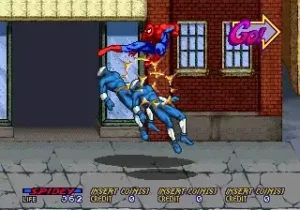
The plot follows Spider-Man and his allies as they race to recover a powerful mystical relic, referred to in some sources as the Sorcerer’s Stone, first from the clutches of the Kingpin and later from the far more dangerous Doctor Doom. True to its genre, the story exists mainly as an excuse to string together a parade of iconic Marvel villains, but the game leans into its comic book roots with genuine enthusiasm, featuring speech-bubble taunts, comic-style sound effect text like “VOK” during hits, and a suitably over-the-top game over screen.
Across the game’s four acts, players battle through encounters with Venom and his symbiote clones, Doctor Octopus, Electro, the Lizard, Scorpion, Sandman, Green Goblin, and Hobgoblin, building toward a climactic showdown with Doctor Doom, notably chosen as the final boss despite his more traditional ties to the Fantastic Four rather than Spider-Man’s own rogues’ gallery.
Four Playable Heroes, Four Distinct Fighting Styles
One of the game’s standout features was its four-player cooperative mode, allowing players to team up as four different Marvel characters simultaneously, each with a unique moveset tied to their comic book powers:
- Spider-Man – The main protagonist, fighting with web-based attacks including web-swinging maneuvers and webbing blasts.
- Black Cat – An acrobatic, cat-like fighter who uses her claws alongside a grappling hook and cable for mobility and combat.
- Hawkeye – The sharpshooting Avenger, relying on his bow and arrows for ranged attacks.
- Sub-Mariner (Namor) – The Atlantean hero, using water-based projectile attacks such as hydro-electric blasts.
Each character could also unleash a special super-powered move tied to their abilities, though doing so drained a portion of their health, adding a layer of risk-versus-reward to combat. High scores were also tracked separately for each character, encouraging players to master multiple heroes rather than sticking with just one favorite.
A Beat ‘Em Up That Becomes a Platformer
What truly set Spider-Man: The Videogame apart from other brawlers of its era was its unusual structural shift mid-level. Each chapter begins as a traditional side-scrolling beat ’em up, tasking players with punching and kicking their way through waves of enemies as they move from left to right across the screen. After defeating a supervillain or two, however, the camera dramatically zooms out, transforming the game into a scaled-down platforming sequence where characters can move in multiple directions and make use of their full range of weapons and special powers.
Once the platforming segment concludes, the camera zooms back in, returning the game to close-quarters brawler action with noticeably larger, more detailed character sprites. This dynamic shift between combat styles, paired with the Sega System 32 hardware’s ability to render large, richly animated sprites, made the game visually distinctive even among other arcade brawlers of the time.
Critical Reception
Spider-Man: The Videogame was well received by critics and arcade-goers alike upon release. The January 1992 issue of Computer and Video Games praised the game’s four-player cooperative gameplay, its impressive graphics featuring large, beautifully animated sprites, and its distinctive zoom in and out camera effect, along with the sheer volume of content packed into its stages. Dragon magazine’s reviewers awarded the game a perfect five out of five stars in their “The Role of Computers” column, while Sinclair User named it one of the best superhero games of the era in a shared award alongside other licensed titles.
Retrospective coverage has continued to view the game favorably, with retro gaming outlets often citing its authentic comic book presentation, from character taunts to sound effect text, as a standout element that elevated it above typical licensed brawlers of its time.
Why This Arcade Game Remains Underrated
Despite its strong critical reception and arcade success, Spider-Man: The Videogame never received a direct sequel and was largely overshadowed in later years by other Marvel titles, including the more widely remembered Spider-Man and Venom: Maximum Carnage on home consoles. Because it was built specifically for Sega System 32 arcade hardware, the game also never received an official home console port, leaving it somewhat obscure compared to other Marvel games of the decade, despite being fondly remembered by those who played it in arcades during its original run.
Legacy and How to Play It Today
While Spider-Man: The Videogame never made the jump to home consoles, it remains playable today through MAME emulation, allowing modern players and retro gaming enthusiasts to experience its four-player brawling action and distinctive zoom mechanics without needing to track down the original arcade cabinet. Its combination of solid brawler fundamentals, genuine Marvel authenticity, and inventive camera work has helped it maintain a dedicated following among collectors and fans of early 1990s licensed arcade games.
Why Spider-Man: The Videogame Still Deserves Recognition
Spider-Man: The Videogame succeeded in capturing the tone and energy of Marvel comics far more convincingly than many licensed games of its era managed to do. Its blend of brawler combat, platforming variety, four-player cooperative play, and genuinely charming comic book presentation make it a standout entry in Sega’s early 1990s arcade catalog. For fans of classic beat ’em ups or Marvel history alike, this is one overlooked arcade cabinet well worth tracking down or firing up in an emulator.
Frequently Asked Questions
1. Who developed Spider-Man: The Videogame?
Spider-Man: The Videogame was developed and published by Sega Enterprises Ltd. in 1991, built specifically for Sega’s System 32 arcade hardware.
2. How many playable characters are in Spider-Man: The Videogame?
The game features four playable heroes: Spider-Man, Black Cat, Hawkeye, and Sub-Mariner, each with a unique moveset and special ability tied to their comic book powers, supporting up to four players simultaneously in cooperative play.
3. Why does the game switch between beat ’em up and platforming sections?
Each level begins as a traditional side-scrolling beat ’em up before the camera zooms out mid-chapter, transforming the action into a platforming sequence with multi-directional movement and expanded weapon use. The camera later zooms back in for continued close-quarters combat, a dynamic shift that set the game apart from other brawlers of its era.
4. Can I still play Spider-Man: The Videogame today?
Yes. Although the game never received an official home console port, it remains playable through MAME emulation, allowing modern players to experience the original arcade version, including its four-player cooperative mode and signature zoom mechanics.
![The King of Fighters 2002 Magic Plus II (bootleg) [Bootleg]](https://www.retrogames.me/wp-content/uploads/the-king-of-fighters-2002-magic-plus-ii-bootleg-bootleg-150x150.webp)