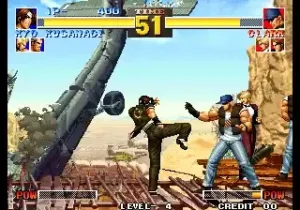
Play The King of Fighters ’95 (NGH-084) online! It is one of the top-rated Arcade games you can play for free. No download, emulator, or setup required—jump straight into the action directly in your browser and start playing this classic in seconds.
The Gameplay Experience
The King of Fighters ’95 introduced a revolutionary four-button control scheme that allowed players to execute a diverse array of combos and special moves. This innovation significantly enhanced the fighting experience, making it more dynamic compared to its predecessors. With characters arranged into teams of three, the tactical element became pivotal; players needed to think strategically about team composition. The game also included a robust system of “Clique Tiers,” which allowed players to see their favorite fighters at their best, encouraging both competitive play and deep personal connections to characters.
Moreover, the difficulty level was a double-edged sword. While newcomers could find it challenging to learn the intricate moves, veteran players appreciated the depth it offered. The balance between accessibility and mastery created a lasting appeal, inviting players back to hone their skills. Over the years, the game’s mechanics have influenced numerous other titles, setting a bar for what a fighting game should deliver.
Historical Significance and Innovations
The release of The King of Fighters ’95 marked a critical turning point in the fighting game genre. As a sequel to the original game released in 1994, it adopted a two-on-two format, evolving into a staple of the series. The game introduced iconic characters like Kyo Kusanagi and Iori Yagami, whose rivalry became a major selling point and has reverberated throughout the franchise. Innovations in graphics also stood out, featuring vibrant, hand-drawn sprites and fluid animations that were groundbreaking for its era.
Notably, the game was one of the first to implement a storyline that unfolded through its matches, enhancing player engagement. The set stages were meticulously designed to reflect the cultural fabric of the characters, making each fight feel meaningful and immersive. This storytelling approach contributed to the game’s longevity and its ability to remain relevant within gaming circles. Players often remember the intricate arrangements of characters and settings that made them feel part of an evolving storyline.
A Lasting Legacy
The legacy of The King of Fighters ’95 extends beyond its immediate gameplay and technical advancements. Its influence can be seen in countless titles, establishing benchmarks that have shaped modern fighting games. Fans continue celebrating its characters and design through various conventions, tournaments, and online discussions, showcasing an enduring community. The game’s nostalgic value resonates, reminding players of a golden era in gaming that continues to inspire new generations.
Conclusion
In conclusion, The King of Fighters ’95 encapsulates a unique moment in the history of fighting games, marrying innovation with engaging mechanics. It built a community that values not just competition but a rich narrative and memorable characters. Even decades later, it continues to be revered for its foundational role in the genre. Whether through nostalgia or its continued playability, the game remains a benchmark for excellence in fighting games, standing the test of time in a rapidly evolving industry.
![The King of Fighters 2002 Magic Plus II (bootleg) [Bootleg]](https://www.retrogames.me/wp-content/uploads/the-king-of-fighters-2002-magic-plus-ii-bootleg-bootleg-150x150.webp)