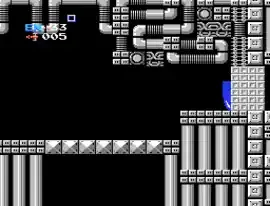
Play Metroid online! It is one of the top-rated Nintendo Entertainment System games you can play for free. No download, emulator, or setup required—jump straight into the action directly in your browser and start playing this classic in seconds.
Metroid for the Nintendo Entertainment System isn’t just a classic action game — it’s the title that gave birth to an entire genre. Released by Nintendo in 1986, Metroid introduced players to a sprawling, interconnected alien world, a legendary twist ending, and one of gaming’s most iconic protagonists, Samus Aran. Nearly four decades later, its influence is still felt across countless modern titles. Here’s everything you need to know about the original Metroid on NES.
What Is Metroid?
Metroid is a science-fiction action-adventure game developed and published by Nintendo, created by Nintendo Research & Development 1 alongside Intelligent Systems. The game first launched in Japan in August 1986 for the Family Computer Disk System, before arriving in North America in August 1987 on the standard NES cartridge format, and reaching Europe in early 1988.
Produced by Gunpei Yokoi and directed by Satoru Okada and Masao Yamamoto, with a memorable score composed by Hirokazu Tanaka, Metroid stood apart from other action titles of its era by rejecting the traditional linear, left-to-right level structure. Instead, it offered an open, maze-like planet for players to freely explore, revisit, and gradually unlock — a structural innovation so influential it eventually lent its name to an entire genre: the “Metroidvania.”
The Story: A Bounty Hunter’s Mission to Zebes
Metroid’s plot centers on an interstellar conflict between the Galactic Federation and Space Pirates operating from the planet Zebes. The pirates have stolen a mysterious lifeform known as the Metroid, a parasitic organism capable of draining energy from any living creature it attaches to. Left unchecked, the Metroids could be weaponized into a devastating biological threat capable of wiping out entire star systems.
To stop them, the Galactic Federation calls on its most capable operative: bounty hunter Samus Aran. Samus infiltrates the pirates’ subterranean base on Zebes, battling through hostile alien wildlife and powerful guardians, including the hulking Kraid and the dragon-like Ridley, before confronting the malevolent computer intelligence known as Mother Brain deep within the planet’s core.
Samus Aran: A Landmark Character in Gaming History
Samus Aran was designed by Hiroji Kiyotake, with the scenario crafted by Makoto Kano, and her visual inspiration reportedly drew from Sigourney Weaver’s role as Ellen Ripley in the film Alien. What made Samus truly groundbreaking, however, wasn’t revealed until the credits rolled.
Throughout most of the game, and even in the instruction manual, Samus is referred to using male pronouns to hide her identity. Players who completed the game quickly enough were rewarded with an ending revealing that the heavily armored hero beneath the Power Suit was in fact a woman, one of the earliest and most memorable examples of a strong female protagonist in video game history. This twist has since been recognized as one of the most celebrated surprises in gaming, and it helped establish Samus as an enduring icon.
Exploration-Driven Gameplay and Power-Ups
Unlike many action titles of its time, Metroid rewarded curiosity and careful exploration over straightforward progression. Samus begins the adventure equipped with only a weak Power Beam and basic jumping ability, but as players push deeper into Zebes’s caves and tunnels, they discover upgrades that fundamentally expand what she can do and where she can go.
- Morph Ball – Lets Samus curl into a compact sphere to roll through narrow tunnels.
- Bombs – Usable only in Morph Ball form, capable of revealing hidden passages in floors and walls.
- Missiles – A stronger ranged weapon needed to defeat tougher enemies and bosses.
- Energy Tanks – Permanently increase Samus’s maximum health.
- Screw Attack – A spinning aerial maneuver that destroys enemies on contact.
This gradual, upgrade-driven approach to unlocking new areas became the defining blueprint for the genre that would eventually bear the Metroid name, encouraging backtracking and rewarding players who remembered where they’d seen an inaccessible passage earlier in their journey.
Multiple Endings and the Password System
Metroid was also notable for offering multiple endings based on how quickly the player defeated Mother Brain and escaped the self-destructing base, one of the earliest examples of a time-based ending system in gaming. Faster completion times revealed increasingly revealing depictions of Samus without her armor, culminating in a special outfit for players who finished the game in under an hour.
Because the NES version lacked the internal battery save system used later by games like The Legend of Zelda, Metroid instead relied on a lengthy password system, a 24-character code players would write down and re-enter to resume progress. This same system enabled one of gaming’s most famous cheat codes, “NARPAS SWORD,” which granted infinite health and ammunition, along with the well-known “Justin Bailey” password that let players start with an alternate outfit.
Atmosphere and Sound Design
Beyond its structural innovations, Metroid is remembered for its unsettling, isolating atmosphere. Hirokazu Tanaka’s score leaned into eerie, minimalist tones rather than upbeat melodies, reinforcing the sense that Samus was an intruder in a hostile, almost organic alien world. As players venture from the relatively tame caverns of Brinstar into the lava-filled depths of Norfair, the tone grows increasingly foreboding, a mood later expanded upon in Super Metroid.
Legacy and Critical Reception
Metroid’s reception over the years has varied depending on the era of review. At release and in later retrospectives, many critics praised its ambitious design, atmospheric world-building, and technical achievements for the hardware of its time. Some later reviews of direct rereleases judged the game more harshly against modern action-adventure standards, though its historical importance and design influence remain widely acknowledged.
The game has been rereleased numerous times over the decades, including through the Classic NES Series for Game Boy Advance and the Nintendo Switch Online service, which added modern conveniences like save states and a rewind feature. Its direct remake, Metroid: Zero Mission, arrived in 2004, offering an expanded and modernized retelling of Samus’s first mission to Zebes.
Why Metroid Still Matters Today
Few games can claim to have named an entire genre, yet Metroid’s blend of nonlinear exploration, gated progression, and atmospheric storytelling continues to shape action-adventure design nearly forty years later. Its introduction of Samus Aran remains a landmark moment for character representation in gaming, and its emphasis on discovery over hand-holding still feels distinct even by today’s standards. For anyone interested in the roots of modern exploration-based games, the original NES Metroid remains essential playing.
Frequently Asked Questions
1. When was Metroid released for the NES?
Metroid was originally released in Japan in August 1986 for the Family Computer Disk System. The NES cartridge version followed in North America in August 1987, with a European release arriving in January 1988.
2. Who is Samus Aran?
Samus Aran is the protagonist of Metroid, a galactic bounty hunter equipped with a powered Power Suit. She was designed by Hiroji Kiyotake and became one of gaming’s most iconic characters after the game’s ending revealed her to be a woman, a surprising twist for its time since she is referred to using male pronouns throughout most of the game.
3. Does Metroid have multiple endings?
Yes. The game features several different endings depending on how quickly the player defeats Mother Brain and escapes the self-destructing base, with faster completion times unlocking additional reveals of Samus without her Power Suit.
4. Can I play the original Metroid on modern systems?
Yes. The original NES version has been rereleased multiple times, including through the Classic NES Series for Game Boy Advance and, more recently, through the Nintendo Switch Online service, which adds features like rewind and save states. Players interested in an expanded retelling can also check out the 2004 remake, Metroid: Zero Mission.