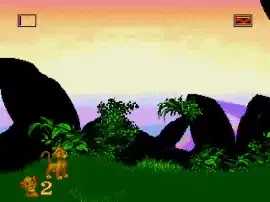
Play The Lion King online! It is one of the top-rated SEGA Genesis games you can play for free. No download, emulator, or setup required—jump straight into the action directly in your browser and start playing this classic in seconds.
Few movie tie-in games from the 1990s are remembered as vividly as The Lion King on Sega Genesis. Released in 1994 alongside Disney’s beloved animated film, this side-scrolling platformer became infamous for its beautiful animation, faithful storytelling, and, above all, its unforgiving difficulty. Decades later, it remains one of the most talked-about entries in the Genesis library, both fondly remembered and mildly feared by anyone who rented it from a video store as a kid. Here’s a full look back at this Disney classic.
What Is The Lion King (Sega Genesis)?
The Lion King is a platform game developed by Westwood Studios and published by Virgin Interactive Entertainment, released for the Sega Genesis (Mega Drive) in November 1994. It launched alongside a Super Nintendo version, both developed in-house by Westwood, while additional ports were later outsourced to other studios for MS-DOS, Amiga, Game Boy, NES, Game Gear, and Master System.
Based directly on Disney’s 1994 animated film of the same name, the game follows the story beat for beat, tracking Simba’s transformation from a carefree young cub into the rightful king who must eventually confront his treacherous uncle, Scar. Development on the Genesis and SNES versions began in January 1994 and wrapped in July of that year, a remarkably tight production window considering the level of visual polish the final game achieved.
A Story Told Through Disney-Quality Animation
One of the most distinctive aspects of The Lion King on Genesis is that its character sprites and backgrounds were hand-drawn by Disney animators at Walt Disney Feature Animation, rather than outsourced to a typical video game art team. The result is a game that captures the fluidity and personality of the film’s animation far more convincingly than most movie tie-ins of its era.
The game closely mirrors the film’s plot, walking players through Simba’s carefree cub years, his exile following his father Mufasa’s death, and his eventual return to reclaim Pride Rock from Scar. Interestingly, two stages, Hakuna Matata and Be Prepared, are based on scenes and concepts that were originally planned for the animated film but ultimately cut before release, giving players content that expands slightly beyond what appeared on screen.
Gameplay: From Playful Cub to King of Pride Rock
Structurally, The Lion King is a side-scrolling platformer in which players guide Simba as he runs, jumps, climbs, and eventually fights his way through levels based on iconic locations from the film. As young Simba, players navigate through more exploratory, puzzle-oriented levels, while playable adult Simba gains the ability to physically battle enemies using his paws, reflecting his growth throughout the story.
One of the game’s most memorable sequences is the Stampede level, which breaks from traditional side-scrolling to have Simba running directly toward the screen, dodging charging wildebeest and leaping over rocks and debris in a tense, high-speed sequence lifted straight from one of the film’s most dramatic moments.
Why This Game Is So Notoriously Difficult
The Lion King’s brutal difficulty has become something of a running joke in retro gaming circles, and it turns out this was intentional. In 2014, game director Louis Castle revealed that Disney specifically pushed the team to make the game more challenging, particularly the second level, “I Just Can’t Wait to Be King,” to prevent players from completing the entire game during a single rental period from stores like Blockbuster. Castle has since publicly apologized for the resulting difficulty spike.
Precision platforming sections requiring pixel-perfect jumps, unforgiving enemy placement, and a final battle against Scar that hinges on an easily missed throw mechanic have all contributed to the game’s reputation as deceptively hard beneath its family-friendly Disney branding, a reputation that persists among players revisiting it today.
Genesis Version vs. Super Nintendo Version
While the Genesis and SNES versions share the same core game, there are a few notable differences between them. The Genesis release lacks background vocals during certain music tracks that are present in the SNES version, but it compensates with more visible background particle effects in levels like the Elephant Graveyard and the Stampede sequence, along with the title screen. Both versions received strong critical reception, though Entertainment Weekly notably rated the SNES version slightly higher than the Genesis release in its original review.
Critical and Commercial Reception
The Lion King was a commercial hit across every platform it launched on. It became the top-selling Sega Master System game in the United Kingdom in November 1994 and the top-selling Game Gear title in the United States the following month. Total sales across all versions have been estimated at around 4.5 million copies. Gameplayers magazine even named it Sega Genesis Game of the Year, notably beating out Sonic the Hedgehog 3 and Sonic & Knuckles, while acknowledging in the same breath that the game was punishingly difficult even on its easiest setting.
Legacy and Modern Re-Releases
The Lion King has enjoyed a long afterlife well beyond its original 1994 cartridge release. It was included in Disney Classic Games: Aladdin and The Lion King, a 2019 compilation developed by Digital Eclipse for Nintendo Switch, PlayStation 4, Windows, and Xbox One, featuring faithfully emulated versions of the Genesis, SNES, and Game Boy releases. A later expanded compilation, Disney Classic Games Collection: Aladdin, The Lion King, and The Jungle Book, followed in 2021, further cementing the game’s status as a defining piece of Disney’s early video game legacy.
Why The Lion King Still Resonates With Retro Fans
Despite, or perhaps partly because of, its brutal difficulty, The Lion King remains one of the most fondly remembered Genesis games of the mid-1990s. Its Disney-quality animation, faithful adaptation of the film’s story, and creative level design set it apart from the sea of forgettable movie tie-ins that flooded the 16-bit era. For collectors and retro gamers alike, it stands as proof that a licensed game could be both a genuine artistic achievement and an unrelenting test of platforming skill.
Frequently Asked Questions
1. Who developed The Lion King for Sega Genesis?
The Lion King was developed by Westwood Studios and published by Virgin Interactive Entertainment. It was released for the Sega Genesis and Super Nintendo in November 1994, with additional platforms later handled by other studios.
2. Why is The Lion King on Genesis considered so difficult?
According to game director Louis Castle, Disney intentionally pushed for increased difficulty, especially in the second level, to prevent players from finishing the game within a typical video store rental period. This resulted in a notoriously punishing difficulty curve that still challenges players today.
3. Are the Genesis and SNES versions of The Lion King different?
Yes. While both share the same core gameplay and story, the Genesis version lacks certain background vocals present in the SNES release but includes more visible particle effects in specific levels, such as the Elephant Graveyard and Stampede stages.
4. Can I still play The Lion King (Sega Genesis) today?
Yes. The Genesis version is included in Disney Classic Games: Aladdin and The Lion King, released in 2019 for Nintendo Switch, PlayStation 4, Windows, and Xbox One, as well as in the expanded 2021 compilation Disney Classic Games Collection: Aladdin, The Lion King, and The Jungle Book.