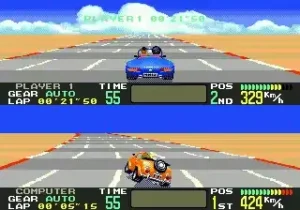
Play OutRunners (Japan) online! It is one of the top-rated SEGA Genesis games you can play for free. No download, emulator, or setup required—jump straight into the action directly in your browser and start playing this classic in seconds.
Revving Up Gameplay Mechanics
OutRunners, released by Sega in 1992, is a standout racing game that showcased not only thrilling gameplay but also the technological prowess of its time. Players competed against one another in a variety of vibrant environments, from busy city streets to serene coastal roads. The game featured a unique cabinet design allowing for multiple players to race concurrently, which was revolutionary in the arcade landscape. This multiplayer aspect fostered a fun and competitive atmosphere, setting a standard for future racing games.
The core mechanics revolved around precise control and drift technique, requiring players to master curves and navigate obstacles at high speed. The simple yet engaging interface made it accessible to newcomers, while at the same time, the difficulty ramped up quickly, challenging even seasoned players to refine their skills. The inclusion of power-ups and branching paths encouraged exploration and replayability, ensuring that every race felt fresh.
A Cultural Snapshot of the Early ’90s
The release of OutRunners coincided with a burgeoning interest in arcade racing games, a genre that flourished during the early 90s. Sega’s commitment to high-quality design and engaging gameplay resonated with players, allowing the title to leave a lasting mark on arcade culture. Its signature soundtrack, a blend of catchy tunes, and the game’s vibrant graphics captured the essence of the era, making it instantly recognizable and nostalgically appealing.
It’s not just about the gameplay—OutRunners came equipped with a diverse selection of cars, each with distinct characteristics and speeds, giving players the chance to tailor their experience. The exciting visual style, together with the colorful environments, made the game visually compelling and an icon of its time. Today, it serves as a nostalgic trip for those who remember the arcade heyday, often sparking conversations about classic gaming among enthusiasts worldwide.
A Lasting Legacy
Years after its release, OutRunners continues to be celebrated for its innovations and gameplay experience. The game’s influence can be seen in many modern racing titles that strive to capture the same exhilarating atmosphere that made it a classic. Whether revisiting the original or modern adaptations, it remains a cherished part of gaming history.
In conclusion, OutRunners stands as a testament to the vibrant arcade culture of the early ’90s. Its blend of accessible gameplay mechanics, memorable graphics, and cultural relevance has secured its place in the pantheon of classic racing games. For fans old and new, this game is not just about racing; it’s an experience that embodies nostalgia and innovation.