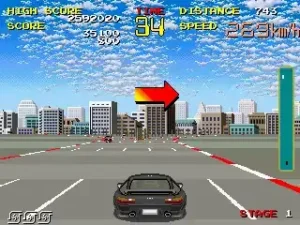
Play Chase H.Q. (Japan) online! It is one of the top-rated Arcade games you can play for free. No download, emulator, or setup required—jump straight into the action directly in your browser and start playing this classic in seconds.
Exploring the Gameplay Mechanics of Chase H.Q.
Chase H.Q. is a hallmark of 1980s arcade gaming that brilliantly devised a unique blend of action and strategy. Players step into the shoes of law enforcement, tasked with pursuing criminals in high-speed car chases. The gameplay revolves around a rudimentary but engaging mechanic—players must not only catch up to but also ram their police car into the getaway vehicle to force it to stop. This requires not just speed but also precision, as players navigate through busy city streets while dodging obstacles and traffic. The game’s increasing difficulty elevates the challenge, with each level introducing faster criminals and more chaotic environments. This relentless pace and tension keep players engaged, making it a classic that continues to attract enthusiasts.
The Historical Significance and Innovations of Chase H.Q.
Released in 1988 by Taito, Chase H.Q. arrived at a time when arcade racing games were gaining popularity. It distinguished itself by combining traditional racing elements with an engaging narrative: players weren’t just racing; they were part of a thrilling police pursuit. The game utilized state-of-the-art graphics for its time, employing smooth scrolling backgrounds and vibrant car sprites to enhance the sense of speed. Additionally, its introduction of a dual-monitor system in some arcade cabinets allowed for more immersive gameplay. The success of Chase H.Q. paved the way for subsequent titles in the genre and even inspired adaptations for consoles, ensuring its legacy would extend beyond the arcade.
Cultural Impact and Legacy
Chase H.Q. remains a nostalgic emblem of retro gaming for many, often invoked in discussions about the evolution of arcade games. Its blend of fast-paced action with a narrative element laid the groundwork for future racing and action titles. The game has not only left an indelible mark on fans but also influenced game design, encouraging developers to incorporate story-driven mechanics into racing games. Furthermore, its presence in contemporary gaming culture, seen through various remakes and references in modern titles, highlights its lasting appeal.
In conclusion, Chase H.Q. has transcended its arcade roots to become a significant piece of gaming history. Its innovative gameplay mechanics, historical significance, and ongoing cultural relevance illustrate why this classic is still cherished today. For both new players and nostalgic veterans, revisiting Chase H.Q. is not just about playing a game; it’s about reliving a pivotal moment in the evolution of video gaming.
![The King of Fighters 2002 Magic Plus II (bootleg) [Bootleg]](https://www.retrogames.me/wp-content/uploads/the-king-of-fighters-2002-magic-plus-ii-bootleg-bootleg-150x150.webp)