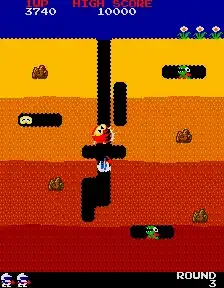
Play Dig Dug (rev 2) online! It is one of the top-rated Arcade games you can play for free. No download, emulator, or setup required—jump straight into the action directly in your browser and start playing this classic in seconds.
Unveiling the Mechanics of Dig Dug
Dig Dug immerses players in a vibrant underground world where strategy meets action. Released by Namco in 1982, this classic arcade game introduced innovative gameplay mechanics that have stood the test of time. At its core, players control the character Dig Dug, who must eliminate underground monsters by either inflating them until they burst or by dropping rocks on them. The game’s unique approach to challenging foes requires not just dexterity but clever planning, as players dig through traversable soil while avoiding dangerous encounters.
The difficulty ramps up as players advance through the levels, introducing denser enemy patterns and faster monster behavior. Each stage pushes players to refine their skills, making every victory immensely satisfying. The dual mechanics of digging and strategic destruction provide layers of depth that keep players coming back, testament to its enduring appeal even decades after its release.
The Legacy and Cultural Impact of Dig Dug
Released during the golden age of arcade gaming, **Dig Dug** quickly captured the hearts of players worldwide, becoming a staple of gaming culture. Its bright graphics and catchy sound design facilitated an engaging experience that resonated with many gamers. Over the years, Dig Dug has been included in numerous game compilations and has inspired various adaptations, affirming its status as a cultural icon.
From its simple yet effective gameplay mechanics to its memorable characters, the game reflects the creativity that defined early video games. Additionally, it has influenced countless titles, serving as a source of inspiration for games featuring digging mechanics. The balance of skill and timing required to face increasingly difficult challenges has solidified **Dig Dug**’s reputation in the annals of gaming history.
Why Dig Dug is Still Relevant Today
Decades later, **Dig Dug** remains a beloved favorite, largely due to its nostalgic value and accessibility. Many players fondly recall their early arcade experiences, making it a recurring title in retro gaming discussions. Its simple controls make it appealing for new players while offering depth and strategy for veterans, ensuring it remains a cherished experience across generations.
Conclusion
In summary, the enduring charm of **Dig Dug** lies in its blend of innovative gameplay, cultural significance, and nostalgic value. The game continues to inspire new audiences while reminding seasoned players of the thrills of classic gaming. Its ingenious mechanics and deep-rooted legacy make it more than just an arcade title; it is a cornerstone of gaming history that still resonates in today’s digital landscape.
![The King of Fighters 2002 Magic Plus II (bootleg) [Bootleg]](https://www.retrogames.me/wp-content/uploads/the-king-of-fighters-2002-magic-plus-ii-bootleg-bootleg-150x150.webp)