Play Flashback – The Quest for Identity online! It is one of the top-rated SEGA CD games you can play for free. No download, emulator, or setup required—jump straight into the action directly in your browser and start playing this classic in seconds.
Long before “cinematic platformer” became a familiar phrase in gaming, Flashback: The Quest for Identity proved that a game could tell a genuinely gripping science-fiction story using little more than fluid animation and clever level design. Originally released by Delphine Software in 1992, the game found its most polished form on Sega CD, where full motion video cutscenes, voice acting, and a lush new soundtrack transformed an already acclaimed cartridge classic into something even more immersive. Here’s a complete look at this landmark title and what makes the Sega CD edition special.
What Is Flashback: The Quest for Identity?
Flashback is a science-fiction cinematic platformer originally developed by Delphine Software International of France and published by U.S. Gold. The game was directed, written, and partially programmed by Paul Cuisset, who had previously created the acclaimed adventure title Future Wars. It first launched on Amiga in 1992 before arriving on Sega Genesis, MS-DOS, Acorn Archimedes, and Super NES throughout 1993.
The Sega CD version, released under the title Flashback: The Quest for Identity in North America, arrived in 1993 as part of a wave of CD-ROM re-releases that also included editions for 3DO, CD-i, and other CD-based platforms. Rather than simply porting the cartridge experience, the Sega CD edition rebuilt the game’s cinematic sequences from the ground up, taking full advantage of the format’s expanded storage and audio capabilities.
The Story: Conrad Hart’s Fight to Reclaim His Memory
Set in the year 2142, Flashback casts players as Conrad B. Hart, an agent who uncovers a chilling conspiracy involving aliens disguised as humans plotting to destroy Earth. Fearing capture, Conrad downloads a backup of his memories onto a device called a Holocube before being caught by his enemies, who wipe his mind and strand him on a hostile, unfamiliar planet.
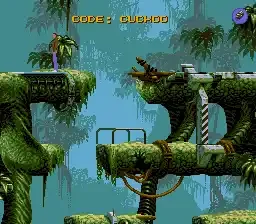
The game opens with Conrad crash-landing in the artificial jungles of Titan, with no memory of who he is or why he’s there. From this point, players guide him through a globe- and galaxy-spanning journey, gradually piecing together his forgotten identity while navigating dangerous environments, outsmarting mutant creatures, and uncovering the full scope of the alien infiltration threatening humanity.
Cinematic Platforming: Gameplay in the Style of Prince of Persia
Flashback’s gameplay draws clear inspiration from Prince of Persia and Delphine’s own earlier title Another World, blending platforming, puzzle-solving, and light combat into a single cohesive experience. Conrad moves with realistic, weighty animation, capable of running, jumping, climbing, hanging from ledges, rolling beneath obstacles, and dropping to lower platforms, all rendered through rotoscoped animation that gave his movements an unusually lifelike fluidity for the era.
For defense, Conrad carries a pistol with unlimited ammunition, along with a rechargeable energy shield that absorbs incoming damage until depleted, effectively serving as his health bar. Rather than pure action, much of the game revolves around exploration and problem-solving, tasking players with gathering information, completing objectives, and figuring out how to reach new areas across each of the game’s seven expansive levels.
What Made the Sega CD Version Different
While the core gameplay across Flashback’s many versions remained largely consistent, the Sega CD edition distinguished itself through a complete overhaul of its cinematic presentation. The Genesis cartridge version told its story through rotoscope-style animated cutscenes, but the Sega CD release replaced these with newly produced, pre-rendered 3D full motion video sequences, giving the introduction and story beats a noticeably more polished, cinematic quality.
Perhaps even more notably, the Sega CD version added full voice acting, both throughout its cutscenes and during in-game dialogue, a feature that set it apart even from other CD-ROM ports of the same game, since later CD-based conversions did not carry over the same voice work or Sega CD-exclusive soundtrack. The console’s audio capabilities also allowed for a redone, atmospheric new-age soundtrack composed specifically for this release, layered with ambient jungle sounds and environmental effects that enhanced the sense of place in each level.
Reception at the Time
Critics generally viewed the Sega CD version as a meaningful upgrade over its cartridge counterparts, even if opinions varied on how substantial those improvements were. GamePro praised the reworked cutscenes as impressive enough that even players who had already finished the game elsewhere would want to experience the new CD footage, while also highlighting the added CD-quality soundtrack and voice acting. Electronic Gaming Monthly took a more measured stance, describing the Sega CD version as close to identical to the Genesis release in terms of core gameplay, while still calling it a worthwhile purchase for newcomers to the series.
The original Genesis version of Flashback had already become a genuine commercial phenomenon, going on to be recognized by Guinness World Records as the best-selling French video game of all time, and Mega magazine ranked it among the top Mega Drive games ever released in 1994.
Legacy of Flashback
Flashback’s influence and reputation have only grown in the decades since its release. Retro Gamer readers voted it among their top retro games in a 2004 poll, and the franchise has continued to see new life well beyond its original 16-bit era. A direct sequel, Fade to Black, arrived in 1995 as a 3D game, and the original Flashback itself received a faithful Remastered Edition in 2018 for Nintendo Switch, PlayStation 4, and Windows. More recently, an entirely new entry, Flashback 2, developed by Microids, was released in 2023 for modern consoles and PC, extending the story’s legacy to a new generation of players.
Interestingly, Paul Cuisset himself has stated in retrospective interviews that he considers the original Mega Drive/Genesis version to be the definitive way to experience the game, noting that it was the platform the title was originally created for, even as the Sega CD version remains celebrated for its cinematic presentation upgrades.
Why Flashback (Sega CD) Still Matters
Flashback: The Quest for Identity on Sega CD represents a fascinating snapshot of early-1990s ambition, a game that used emerging CD technology not just to add flash, but to genuinely deepen an already compelling science-fiction narrative. Between its rotoscoped animation, atmospheric puzzle-driven level design, and one of the more cinematic presentations the format had to offer, this version remains a must-play for anyone exploring the artistic peak of the Sega CD library.
Frequently Asked Questions
1. When was Flashback: The Quest for Identity released on Sega CD?
The Sega CD version of Flashback: The Quest for Identity was released in 1993, following the original Amiga release in 1992 and the Sega Genesis cartridge version released earlier the same year.
2. What’s different about the Sega CD version compared to the Genesis version?
The Sega CD edition replaced the Genesis version’s rotoscope-style cutscenes with newly produced pre-rendered 3D full motion video sequences, added complete voice acting for both cutscenes and in-game dialogue, and featured an exclusive new-age soundtrack composed specifically for the CD format.
3. How long does it take to complete Flashback?
Flashback contains seven levels, and experienced players familiar with its puzzles can typically finish the entire game in around four hours. The game uses a password system to let players continue at the start of each level.
4. Is Flashback available on modern platforms?
Yes. Flashback: Remastered Edition, an updated port of the original game, was released in 2018 for Nintendo Switch, PlayStation 4, and Windows. A new sequel, Flashback 2, developed by Microids, was also released in 2023 for PlayStation 5, Windows, and Xbox Series X/S.