Play Heart of the Alien online! It is one of the top-rated SEGA CD games you can play for free. No download, emulator, or setup required—jump straight into the action directly in your browser and start playing this classic in seconds.
Some sequels become just as beloved as the originals they follow. Others quietly fade into obscurity despite genuine ambition. Heart of the Alien falls somewhere in between, a Sega CD-exclusive follow-up to the groundbreaking Another World (known as Out of This World in North America) that flipped the story’s perspective, expanded its cinematic scope, and became one of the most unique console exclusives of the mid-1990s. Here’s a full look at this overlooked sci-fi adventure.
What Is Heart of the Alien?
Heart of the Alien is a cinematic platform game released in 1994 exclusively for the Sega CD in North America. The game served as a direct sequel to 1991’s Another World, continuing the story immediately from where the original left off. Development was primarily handled by Interplay Productions, working in collaboration with Delphine Software International, and the finished game was published by Virgin Interactive Entertainment.
Rather than releasing as a standalone disc, Heart of the Alien was bundled together with an upgraded version of the original game on the same Sega CD release, titled Heart of the Alien: Out of This World Parts I and II. This packaging gave players the ability to experience both the original adventure and its sequel back to back, complete with Redbook CD-quality audio and newly added full-motion video cutscenes not present in earlier ports of the first game.
The Story: Playing as Buddy for the First Time
Heart of the Alien picks up immediately after Another World’s famously ambiguous ending, in which the human protagonist Lester Chaykin is rescued by his alien companion, known simply as Buddy, and the two flee together on the back of a large flying creature. The sequel opens with that same pterodactyl-like creature landing in the ruins of Buddy’s home village, with an unconscious Lester in tow.
For the first time in the series, players step into Buddy’s role rather than Lester’s. With Lester resting to recover from his injuries, Buddy discovers that the people of his village remain enslaved under the rule of a mysterious tyrant known as the Warden. Determined to free his people and find a way to send his human friend home, Buddy sets out on a dangerous journey through his ruined homeland, confronting new threats and uncovering more of the alien world’s backstory along the way.
Gameplay: Familiar Mechanics, New Alien Abilities
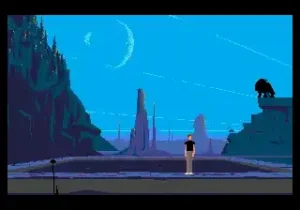
Heart of the Alien retains much of the control scheme and cinematic platforming style that made Another World so influential, blending real-time action, environmental puzzles, and tightly choreographed cutscenes into a single seamless experience. True to the series’ minimalist design philosophy, the game features no heads-up display, relying entirely on visual storytelling and environmental cues to guide the player.
As Buddy, players gain access to several new abilities tied to his powerful energized whip, which can be used both offensively and for traversal, including the ability to swing from stalactites and similar overhead objects to cross otherwise impassable gaps. Unlike Lester’s shield in the original game, which required a brief charge-up period, Buddy’s shield deploys instantly, offering a slightly different rhythm to combat encounters. Much of the game’s challenge revolves around precise timing and trial-and-error problem solving, often built around tense “shoot or be shot” scenarios and carefully placed environmental hazards.
A Troubled Sequel: The Story Behind Development
Unlike the original Another World, which was almost entirely the singular vision of French designer Éric Chahi, Heart of the Alien marked a significant shift in direction, developed primarily by Interplay Productions rather than Chahi himself. According to later accounts, Chahi’s involvement was limited to an early suggestion about exploring the story from the alien’s perspective, a concept that was reportedly misunderstood and expanded into a full sequel without his direct creative input.
Following the game’s release, Chahi publicly distanced himself from the project, stating that it did not represent his original vision for the world he had created and effectively disowning it as an official continuation of the story. Despite this, the game still credits key contributors including designer Jeremy S. Barnes, composer Tommy Tallarico, and executive producer Brian Fargo, reflecting Interplay’s significant creative stamp on the final product.
Critical Reception
Heart of the Alien received a largely positive critical reception upon release, despite frequent criticism of its unforgiving difficulty. GamePro praised the game as an improvement over the original Out of This World in several respects, highlighting its sharply animated cutscenes, clever level design, and atmospheric soundtrack, while acknowledging that its controls could feel frustrating at times. Electronic Gaming Monthly’s reviewers echoed similar sentiments, praising the game’s cinematic sequences, fitting visual style, and engaging puzzle design despite similar control-related complaints.
Retrospective reviews have generally agreed that while Heart of the Alien doesn’t quite match the groundbreaking impact of its predecessor, it remains an enjoyable and worthwhile continuation of the story for fans willing to push through its notoriously punishing difficulty, where a single wrong move on almost any screen can result in instant death.
Legacy and Modern Preservation
Following years of being unsupported and difficult to access on original hardware, Heart of the Alien found new life thanks to dedicated fan preservation efforts. A fan reverse-engineered the game’s binary to extract a functional variant of its source code, which was subsequently released as an open-source project, allowing the game to run on modern platforms through community-developed tools like Heart of the Alien Redux. An unofficial Amiga port has also since been released, built using assets from the original Sega CD release, extending the game’s reach to yet another platform decades after its initial launch.
Why Heart of the Alien Still Matters
Despite its complicated development history and the original creator’s public disavowal, Heart of the Alien remains a fascinating artifact of early-1990s cinematic platforming, a genre that Another World helped pioneer. Its willingness to tell the story from an entirely new perspective, combined with its atmospheric visuals and unrelenting challenge, has earned it a small but dedicated following among fans of Delphine Software’s era-defining sci-fi output. For anyone who fell in love with Another World’s haunting, wordless storytelling, Heart of the Alien offers a worthwhile, if demanding, continuation of that journey.
Frequently Asked Questions
1. Is Heart of the Alien a direct sequel to Another World?
Yes. Heart of the Alien continues the story immediately after Another World’s ending, though original creator Éric Chahi later publicly distanced himself from the game, stating it did not reflect his original vision and was developed largely without his creative input.
2. Who do you play as in Heart of the Alien?
Unlike the original game, where players controlled the human protagonist Lester, Heart of the Alien puts players in control of Buddy, Lester’s alien ally from Another World, as he attempts to free his enslaved people and help Lester return home.
3. Was Heart of the Alien released on any platform besides Sega CD?
The original release was exclusive to the Sega CD in North America. However, following years of unavailability, fans reverse-engineered the game’s source code to create an open-source version, and an unofficial Amiga port has also since been released using assets from the original Sega CD game.
4. Why is Heart of the Alien considered so difficult?
The game features unforgiving, trial-and-error gameplay where a single mistimed action or wrong step on nearly any screen can result in instant death. This punishing difficulty, inherited in part from Another World’s own design philosophy, has been a consistent point of both criticism and praise in reviews of the game.