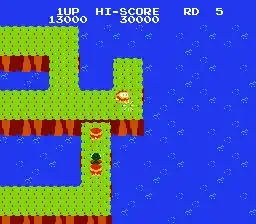
Play Dig Dug II (Japan) (Disk Writer) online! It is one of the top-rated Famicom Disk System games you can play for free. No download, emulator, or setup required—jump straight into the action directly in your browser and start playing this classic in seconds.
Gameplay Mechanics and Challenge
Dig Dug II, released in 1985, redefined the arcade gaming experience with its unique mechanics. Building on the original’s premise of digging tunnels to defeat enemies, this sequel introduced a vibrant world and new strategies. Players navigate through an island landscape where hydraulic pumps are used to inflate and burst foes. This twist adds layers of difficulty and strategy, as players must carefully map out their moves to avoid getting trapped.
The game’s challenge lies in its mechanics. Unlike its predecessor, players can’t simply dig through the ground unimpeded; they must consider the layout of the terrain and enemy movements. This creates a game that balances risk and reward, making each level a fresh puzzle to solve. As players combine digging and inflating, they discover various pathways and tactics that enhance replay value and deepen the immersive experience.
Historical Context and Innovations
When examining the historical backdrop of Dig Dug II, it’s essential to highlight its connection to the golden age of arcade games. Released during the mid-1980s, this title stood out not only for its engaging gameplay but also for its technical innovations. The bright graphics and fluid animations for the time showcased the advancements in pixel art and sound design, enhancing the overall playability.
This sequel also marked Konami’s effort to expand on the growing popularity of arcade cabinets. Players often fondly recall memories of summer afternoons spent at local arcades, making Dig Dug II a staple in the gaming community. The game’s mechanics encouraged social interaction, as friends would frequently challenge each other for high scores. The implementation of multi-level designs kept gamers coming back, significantly contributing to its endurance in gaming history.
Cultural Significance and Legacy
The cultural impact of Dig Dug II continues to resonate today. It has inspired various remakes and adaptations across multiple platforms, affirming its legendary status. The game embodies nostalgia for those who grew up in the arcade era, reminding players of simpler times where multiplayer experiences were shared in person rather than online.
- Introduced unique gameplay mechanics with hydraulic pumps.
- Built on the legacy of its predecessor.
- Innovative graphics and sound design for the time.
In conclusion, Dig Dug II remains a beloved gem in the annals of arcade history. Its gameplay mechanics, innovative designs, and cultural significance ensure that it continues to attract new players while evoking nostalgia in long-time fans. As gaming evolves, the foundational elements established by titles like this remind us of the joy and challenge that gaming can offer.